“The main business of humanity is to do a good job of being human beings … not to serve as appendages to machines, institutions, and systems.” -Kurt Vonnegut, “Player Piano,” 1952
Both the National Ready Mixed Concrete Association’s (NRMCA) ConcreteWorks 2026 and the AggNexus Digital Innovation Conference were filled with people who shape the aggregate and ready mixed concrete industries. They were also filled with constant chatter about … AI chatbots! While agentic AI is today’s hot, scary topic, we need to look further down the road.
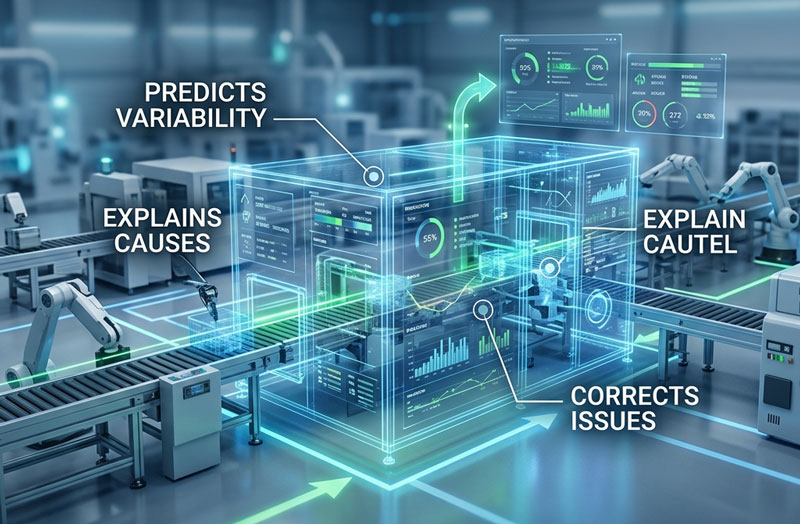
The next scary step will be a well-rounded digital twin that replicates and monitors the entire procurement, manufacturing and delivery process. That sounds intractably terrifying until we take a breath and understand what a digital twin actually is, how it diverges from what we have now, and why it WILL become the most important technology in our industry.
Classic control and command
For three generations, rock and ready mixed production has been controlled by the sensor-dashboard-operator loop. Everyone reading this knows someone who is uncannily good at it and is probably retiring in the next few years. While increasingly sophisticated, the sensors and dashboard are essentially dumb servants to the skilled operator.
A great operator knows not only history but also the cause-and-effect relationships. They understand the countless little mechanisms that affect production and how those mechanisms interact. They know when a change matters, when it does not, and when seemingly related events are just coincidence.
That last point matters most. Correlation is not causation. Ice cream sales and shark attacks both rise during summer, but nobody is blaming Ben & Jerry’s Cherry Garcia for “Jaws.”
The fundamental limitation of this model is scope and scale. Material supply affects manufacturing. Manufacturing affects quality. Quality affects sales, and sales affect demand for more material supply. Yet most of our technology sees only one little piece. When this scope-limited approach is scaled throughout the enterprise, our biggest enemy– mean Mr. Variability – thrives.
Birth of the twin
If you doubt the inevitable impact of digital twins, Vonnegut’s novel “Player Piano” weighs in on the transformation: “Nobody’s so damn well educated that you can’t learn 90 percent of what he knows in six weeks. The other 10 percent is decoration.” And that was 74 years ago!
A digital twin is generally defined as a passive, data-driven replica of a physical object, process, system, or even a human that continually updates using real-time data and can make recommendations for human interpretation. Consider a digital twin as your helpful friend and agentic AI as wanting to get rid of you.
Today, we can use the current, widely available AI platforms to create our own primitive digital twins. We need to feed them questions we face, the answers we have, the decisions we make, and the lessons we learned today and through the decades. Consider it a modern “Dear me” diary. I have two, one on ChatGPT and the other on Claude, and it’s oddly reassuring that they routinely disagree with each other.
Apply the same concept to an operating business. Instead of sensor, dashboard and operator, imagine sensor, digital twin, prediction, explanation, recommended correction, and then operator or, when appropriate, automated action.
Importantly, the operator remains in the loop. There are common-sense regulatory, safety and operational necessities that ensure a human stays involved. Humans remain remarkably good at identifying context, questioning assumptions and separating correlation from causation. While agentic AI seeks to make decisions liberated from inconvenient humans, the digital twin does not eliminate the operator; it gives the operator a much bigger brain.
Transcend from documentation to anticipation
As an example, aggregate gradation is an unspoken problem, perhaps because most of us have just accepted it. But gradation variability has a huge impact on concrete performance. Evolving vision systems can now spot-check stockpiles and continuously examine material moving across a belt.
A digital twin replicating and monitoring the process will, subject to human oversight, make real-time corrections to concrete mix design to account for gradation variation, because it understands what that variation means downstream. The twin could compare current gradation against historical plant performance, mix design, moisture, strength, etc. It could then recommend and, in “safe” situations, make real-time adjustments to the concrete mixture before variability reaches the customer.
Now imagine going further: A digital twin following a load from stockpile to jobsite. It sees aggregate moisture change after a morning rain. It watches actual batch weights, mixer amperage, temperature, revolutions and aging, all the way through jobsite conditions like slump, air and the long-term strength curve. This information lives in separate systems. A digital twin can connect them for actionable suggestions.
If morning loads begin arriving high in slump, the twin will sound the alarm AND ask why. What was the root cause of the variation? It then predicts the next load and, subject to human oversight, corrects the mix or other factors as needed.
That is the breakthrough. We transcend documentation and arrive at anticipation. Variability becomes something we manage before the customer ever sees it.
Next steps
Technology providers are woefully behind in embracing what AI is destined to become, remaining fixated on what they know: agents, dashboards and individual applications. While useful, these are not the destination.
The time to build a digital twin control loop is now. Our highly skilled operators are rushing toward retirement. Not only will we preserve their knowledge; through human guidance, we will enhance it.
There will be mistakes and oversights, some so spectacular that the Luddites will point to them as reasons to go back. We should do the exact opposite: build machines that become human appendages.
Related Article: The New (AI) Luddites of Ready-Mix


