Artificial intelligence is not optional. It is a primary support for world-leading economic and military power; and building that power means building data centers—fast.
The cloud is badly named. As the host of the math and data of artificial intelligence (AI), it sounds weightless. The misnomer leads us to believe answers magically appear inside a laptop when we ask a question.
AI is physical. It requires infrastructure and electricity. It also requires an astounding amount of ready mixed concrete.
The concrete math
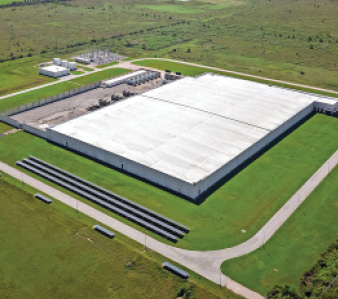
Consider a recent data project in Houston for Serverfarm, a U.S.-based data center developer and operator. The 60-MW, AI-ready CTX2 facility required approximately 45,000 cubic yards (cy) of concrete. That works out to about 750 cy per installed megawatt, or 750,000 cy per gigawatt of data center capacity—and that figure is well below the international average. For planning purposes, 1 million to 1.5 million cy of ready mixed concrete for each gigawatt of new data center capacity is a reasonable working range.
A gigawatt-hour (GWh) measures energy consumed over time. A 1-GW data center operating at a 90-percent load factor consumes about 7,884 GWh annually. Using a value of about 1.1 million cy per gigawatt brings the number closer to 135 cy per annualized GWh.
About $300,000 per consumed gigawatt-hour: That is the retail price typically charged in the U.S. for usage at an AI-ready data center. I don’t care if we put gold flakes in the mix—the concrete cost is a rounding error! What really matters is bringing the data center online as quickly as possible, also known as time to market.
The demand is extraordinary, and thankfully, the U.S. is leading the world in both capacity and ease of building. Global estimates of capacity vary, ranging from roughly 70 to 120 GW. What is clear is the huge U.S. lead, with an estimated share of about 45 percent. The nation’s low barriers to construction make it the best place to build even more, while other nations continue to add friction and delay.
Jones Lang LaSalle (JLL) estimates that nearly 100 GW of new data center capacity could be added worldwide between 2026 and 2030. Multiply 100 GW by roughly 1 million cy per gigawatt, and suddenly we are discussing something on the order of 100 million cy of concrete, with the U.S. as the clear frontrunner for at least half of it. AI is the largest emerging market our industry has seen in decades.
Time is money
Ben Franklin sagely advised, “Remember that time is money.” That truth holds in capital letters for today’s data center construction.
JLL estimates average 2026 data center construction costs globally at about $11.3 billion per gigawatt. At an assumed 8-percent cost of capital, an 18-month delay carries about $1.36 billion in financing opportunity cost. The price of loitering is extraordinary.
The best thing our industry can do as a construction partner is reduce waiting time. Concrete takes time to cure. That makes anything that reduces time to strength especially valuable.
For example, a ready mixed producer in Ohio is working with concrete technologies company alterBiota to test a carbon-negative admixture derived from stranded biomass for major data center projects in the state. The technology offers the potential to accelerate strength development while advancing the goal of lower-carbon construction by permanently storing biogenic carbon in the concrete.
That is exactly where our industry belongs: not simply supplying concrete but helping to accelerate the project.
Can space compete with the USA?
One proposed alternative to building AI infrastructure on the ground is to place computing capacity in orbit. The idea is no longer science fiction, but the economics do not yet work.
Large satellite constellations could function as distributed data centers, linking hundreds or thousands of kilowatt-scale nodes into a single computing resource. The concept has obvious appeal. It could, in theory, shift compute closer to abundant solar energy in space and bypass some terrestrial constraints. SpaceX has discussed ambitions at massive scale, and Starcloud is pursuing a similar basic concept.
However, mass is the problem. Launching compute into orbit is still extraordinarily expensive. At roughly 34 to 59 kg of launched mass per kilowatt, 1 GW of orbital compute would require approximately 40 million kg placed into orbit. Even with an extremely aggressive future launch cost of $500 per kilogram (versus $3,000/kg today), transportation alone would cost about $20 billion for 1 GW, or about $2.5 million per annual gigawatt-hour.
And remember, the average retail price for consumers is now around $300,000/GWh at 90-percent capacity. Now add in the processors, hardware, and associated orbital networking. Space-based compute deserves serious research, and eventually it may become important, but it currently cannot compete with terrestrial data centers.
Let’s build!
The U.S. combines stability, the rule of law, and strong capital markets with world-leading technology companies and a continental-scale electrical system. Our competitors understand what is at stake. We have the opportunity to become the undisputed home of the AI age, but only if we build with urgency.
Originally published in Concrete Products, September 2026.


