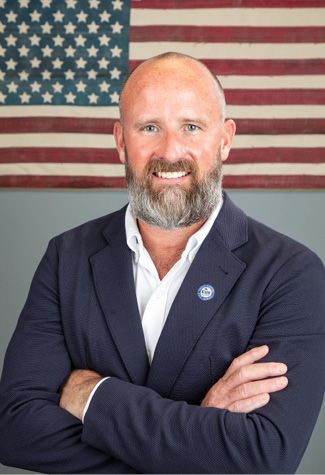
Chris Davenport began his concrete industry career with an opportunity that had no proven track record. When Middle Tennessee State University launched its Concrete Industry Management (CIM) program in 1996, Ward Poston Jr. of Holcim encouraged Chris to consider it. A marketing manager at Holcim and widely regarded as one of CIM’s founding fathers, Poston helped shape the degree program in its earliest days. With scholarships available, Chris also saw the possibilities.
Chris joined the program’s inaugural class and became the first graduate among eight students determined to complete the program on schedule. His degree decision launched a career spanning materials, equipment, sales and business ownership.
Chris spent seven years with Master Builders Solutions and 14 with Barns Industrial Group and CON-E-CO. He later founded Southern Concrete Machinery (SCM), representing Astec and other manufacturers in Alabama, Kentucky, Tennessee, Arkansas and Mississippi. In 2023, he purchased the business of longtime friends Dan Burton, Neil Minnihan and Randy Howe, expanding into Indiana, northern Illinois, Ohio and Michigan. Burton’s son Nick now works on Chris’s sales team.
Sell with your ears
Early in his career, Chris struggled to develop the clear, consistent message needed to sell major capital equipment. He still recalls a piece of advice from Master Builders Solutions Vice President of Sales Tom Guennewig (now retired): “Sell with your ears, not your mouth.”
That lesson became central to his approach. Customers often explain what they need, what they value, and what they are willing to purchase. The salesperson’s job is to listen, observe and understand how those priorities fit the available solution. A concrete plant is not a commodity. It is a major fixed investment affecting profitability. Producers need confidence in both the equipment and the people supporting it.
Chris also insists that customer size should never determine service quality. A producer with one plant deserves the same professionalism and courtesy as a producer with 100 plants.
“We can’t get rich off every deal,” Chris says. “Sometimes we have to get to work.”
To his credit, Chris is willing to work like a rented mule.
Humility and a hunger to learn
His advice to people entering the industry begins with humility and a hunger to learn. Young professionals must be self-reliant, but flexible enough to be schooled by experienced people. Most senior leaders worked their way up and have seen both the right and wrong ways to solve problems.
Chris summarizes his philosophy simply: “You never lose if you always learn.” When an opportunity does not go as planned, he meets with his team to examine what happened. Sometimes they could have performed better. Other times, the project may not have been a good fit. The goal is to learn and improve.
This approach did not develop on accident. Three industry mentors helped steer Chris in the right direction. They did not tell him exactly what to do. Instead, they explained what they saw and allowed him to decide how to apply it. A productive mentoring relationship requires honest conversation and the self-confidence to hear difficult observations.
Mentorship, however, cannot replace work ethic. Chris believes young people entering the concrete industry should expect long hours, extensive travel, and time away from family. At the time of the interview, he had already spent 122 nights in hotels over the course of seven months.
“You have to cut the hay when the hay needs cut,” he says.
He worries that some young employees expect rapid advancement without first developing the skills needed to lead. Technology provides immediate access to information, but dependence on phones and artificial intelligence can weaken critical thinking when people stop learning how to solve unfamiliar problems.
Industry grows more complex
Technology will improve the industry, says Chris, but concrete will remain a demanding, blue-collar business that takes time to master.
He expects major technological change in ready mixed concrete delivery and production. Innovations like autonomous trucks will eventually play a role, but concrete is not ordinary freight. It is a highly engineered, perishable product requiring coordination among the plant, dispatcher, driver, contractor and jobsite.
Concrete production is also becoming more complicated. A generation ago, a plant might have used air entrainment, a water reducer, a retarder, and an accelerator. Chris recently installed a plant that included 14 admixture systems.
Our industry continues to weather the impact of many challenges, not least of which are portland-limestone cement, limited fly ash supplies, slag, calcined clay, and new admixtures. Successful mitigation is adding complexity. Plants are also becoming faster and more accurate through better controls and inventory systems.
Yet automation makes skilled people more important, not less. Quality still depends on people who understand how concrete—with its inherent demanding schedules—will perform in the field.
Giving back
Chris is proud of the businesses he has built, but even prouder of his team. His goal is to create the premier ready mixed concrete plant dealership in the country while providing stability and opportunity for employees and their families.
He describes himself as a product of the industry and wants to give back.
That commitment brings him back to CIM. The program was created to develop graduates with business management and concrete-industry expertise, and it remains one of the industry’s strongest pipelines for future leaders. Chris believes the program is one of the concrete industry’s best tools for developing young talent. The industry must continue investing in graduates through mentoring, accountability and opportunity.
His message to the next generation is as plainspoken as he is: Listen carefully. Respect experience. Work hard. Learn from mistakes.
Learn more about the CIM Program at www.concretedegree.com.
Originally published in Concrete Products, August 2026.


