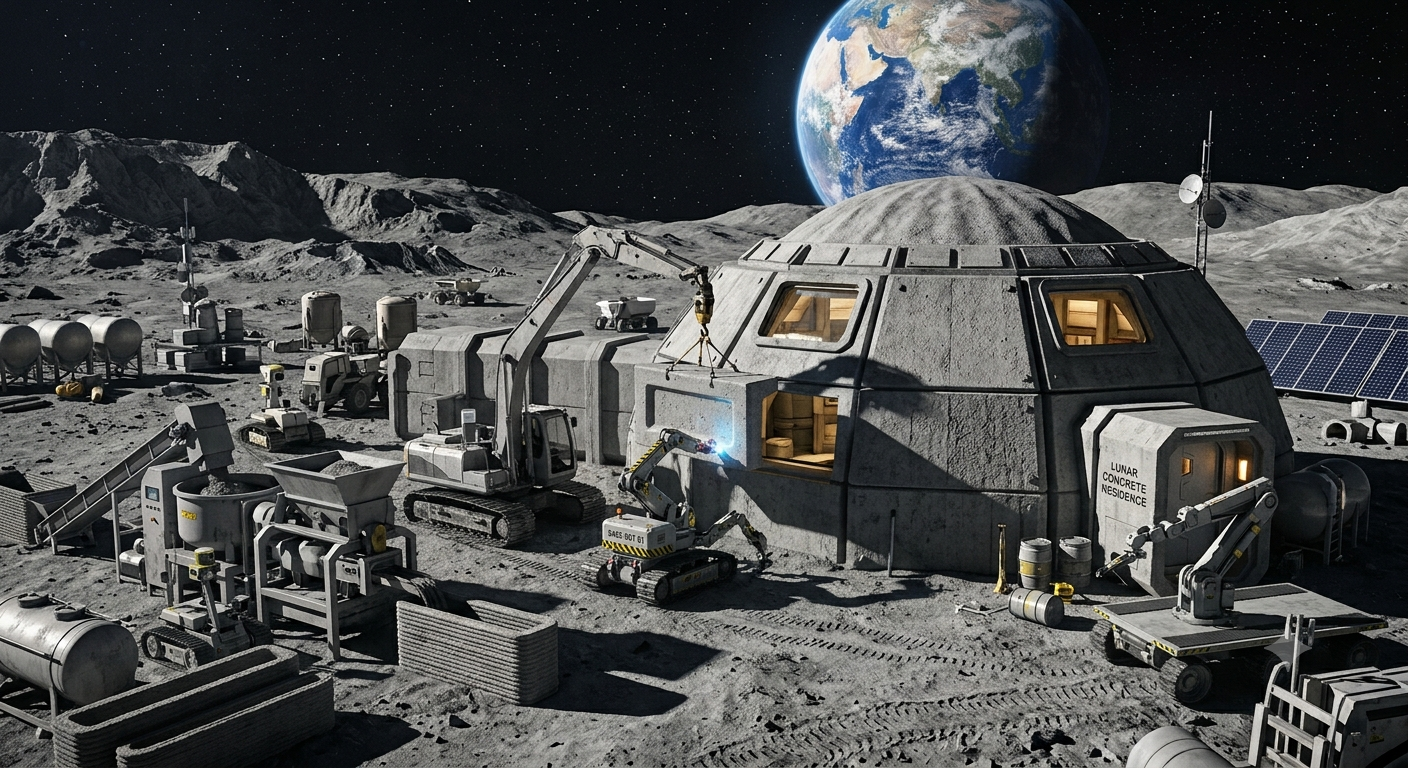
From science fiction to strategic necessity.
For generations, the idea of building on the moon belonged to the realm of science fiction. Futuristic illustrations of lunar cities beneath giant domes and their supporting technology seemed to be perpetually decades away.
That future may be arriving far sooner than many realize, but with a military twist. The high ground always matters, and the moon is the highest within our reach. History’s leading military thinkers have long understood this principle:
- Sun Tzu, “The Art of War” (4th century BC): “… you should occupy the raised and sunny spots, and there wait for him to come up.”
- Vegetius, “De Re Militari” (5th century AD): “The nature of the ground is often of more consequence than courage.”
- Carl von Clausewitz, “On War” (1832): “Elevated positions confer three advantages: greater obstacle to approach, better observation, and the moral effect of looking down on an opponent.”
- Lyndon B. Johnson, statement to the Preparedness Investigating Subcommittee of the Senate Armed Services Committee (1958): “Control of space means control of the world.”
The doctrine never changed—only the altitude did. And there’s a fitting irony for our industry: every high ground in history was held by fortifying it. The side that can build on the moon, not merely reach it, is the side that holds it. Hence, the trillions being invested right now by superpowers across the globe.
Construction on the moon is the one challenge that towers above nearly all others. Human survival requires durable shelter from extreme temperatures, solar radiation, micrometeorite impacts, and abrasive lunar dust. Transporting conventional construction materials from Earth is economically impractical. The obvious solution is one that the ready mixed concrete industry understands well: use local materials.
The ultimate local aggregate source
The moon is covered by a layer of fragmented rock and dust known as lunar regolith. Created over billions of years by meteorite impacts, regolith contains silicates, oxides, and mineral particles remarkably similar to materials already familiar to concrete producers.
Researchers are investigating ways to turn lunar regolith into structural materials using a variety of approaches: sulfur-based concrete systems; geopolymer binders; sintered regolith product; 3D-printed lunar construction materials; and, regolith-derived cement alternatives.
The objective is simple: minimize imported materials while maximizing the use of resources already available on the lunar surface.
In many ways, lunar construction resembles the industry’s ongoing efforts on Earth to reduce cement consumption, use alternative binders, and improve sustainability. The difference is that on the moon there is no alternative. Resource efficiency is not an environmental preference; it is a survival requirement.
3D printing changes everything
One of the most promising technologies for lunar construction is large-scale additive manufacturing. Instead of transporting crews of tradespeople and fleets of construction equipment, robotic systems could arrive first and begin constructing infrastructure autonomously. Using regolith-based materials, giant printers could build landing pads, protective walls, storage facilities, and eventually living quarters before astronauts ever arrive.
The concept mirrors developments already underway within the concrete industry. Around the world, contractors are printing homes, bridges, retaining walls, and infrastructure components. While still emerging, these technologies provide a valuable proving ground for techniques that may be deployed beyond Earth. The moon may become the ultimate test site for automated “concrete” construction.
The harshest environment imaginable
Lunar construction faces challenges that make terrestrial projects seem easy by comparison. Temperatures can swing hundreds of degrees between lunar day and night. There is virtually no atmosphere. Water is scarce. Gravity is only one-sixth that of Earth.
Traditional hydration chemistry behaves differently under such conditions. Material performance, thermal movement, durability, and placement methods must all be reimagined. Even lunar dust presents a major engineering challenge. The sharp, abrasive particles infiltrate equipment, damage seals, and threaten mechanical systems.
Future lunar construction specialists will spend as much time studying materials science, robotics, and environmental systems as they do traditional construction practices.
Why this matters to the industry
It is tempting to dismiss lunar concrete as an interesting scientific curiosity. That would be a mistake.
History repeatedly demonstrates that technologies developed for extreme environments eventually find applications on Earth. Space programs have already contributed innovations in communications, materials, sensors, navigation, and computing. The same pattern will emerge with lunar construction.
Research into low-water binders, autonomous production systems, advanced materials characterization, robotic placement, and additive manufacturing could directly influence future ready mixed operations. Imagine an end-to-end process with minimal human intervention, replete with robotic placement systems working continuously in hazardous environments.
These concepts seem futuristic now, but so did carrying a supercomputer in your pocket.
The first permanent lunar structures may not resemble the buildings depicted in science fiction movies. They may be simple protective shelters, landing pads, storage facilities, or underground habitats covered with regolith.
Yet those first structures will represent something profound. For the first time in human history, construction materials will be manufactured and utilized beyond Earth.
And when that milestone arrives, the technologies involved will likely have roots that every concrete producer recognizes: aggregates, binders, mix design, material optimization, and the timeless challenge of turning local resources into durable infrastructure. The location may be 238,900 miles away. The fundamentals remain surprisingly familiar. The next great chapter in construction may not be in Texas, Ohio, or Saudi Arabia. It may be on the moon.
Article originally published in Concrete Products July 2026.


